
An anthropometric assessment uses standardized measurements — including body weight, height, circumferences, skinfold thicknesses, bone breadths, and limb-segment lengths — to describe an individual's body shape and proportions. In sport, it helps practitioners characterize an athlete, monitor changes throughout the season, and inform decisions about training, nutrition, and equipment. This guide explains what an assessment involves, how measurements are taken, what the results can and cannot tell us, and why anthropometry matters to cyclists — including when they sleep.
ONIRIC
Sleep support shaped around your body
Oniric combines anthropometric data, pressure mapping, and an understanding of your sleep habits to recommend an ergonomic sleep system suited to your body.
Explore Sleep Fitting™Key takeaways
- An anthropometric assessment describes body shape using calibrated equipment and a standardized protocol. In Spain, the Spanish Sports Council (CSD) provides reference procedures informed by ISAK recommendations.
- The results can be used to estimate body composition, shape, and proportions. They do not replace functional assessment or body-pressure analysis.
- For cyclists, limb proportions and riding position can influence comfort, muscle activation, and pressure distribution.
- For sleep-system selection, anthropometry provides a starting point, which can be complemented by pressure mapping and an assessment of sleep habits.
What Is an Anthropometric Assessment?
Anthropometry is the measurement of the human body's dimensions. Common measures include height, weight, body mass index (BMI), circumferences, and skinfold thicknesses, as described in the literature on anthropometric measurement. An anthropometric assessment follows a consistent protocol so results can be compared across sessions, between athletes, and with reference populations.
The same measurement methods can serve three different purposes:
Clinical and nutritional: assessing health and nutritional status, including growth, cardiometabolic risk, and changes during dietary treatment.
Sports performance: describing an athlete's physique, monitoring body composition throughout a season, and relating physical characteristics to the demands of a sport.
Ergonomics: using body dimensions to adapt equipment or a surface — such as a bicycle, seat, or sleep system — to its user.
The third application receives less attention in general guides, yet it matters to athletes who carefully manage their training. The body is more than a set of measurements: its proportions affect how loads are distributed across joints and tissues, both on the bike and while lying in bed.
What Measurements Does It Include?
There is no single measurement protocol for every person or purpose. The assessment should reflect the question being asked and the sport involved. As a starting point, the Spanish Sports Council (CSD) includes measurements such as weight, standing and sitting height, arm span, shoe size, chest, waist and hip circumferences, and arm, leg and thigh lengths in its sports development anthropometry protocol. Additional measures depend on the purpose of the assessment.
Common measurements can be grouped as follows:
| Measurement type | Examples | What it helps estimate |
|---|---|---|
| Basic measurements | Weight, standing height, sitting height, arm span | Overall body size and torso-to-limb proportions |
| Circumferences | Chest, waist, hips, upper arm, thigh, calf | Relative muscle size and fat distribution |
| Skinfolds | Triceps, subscapular, abdominal, thigh | Subcutaneous fat and estimated body composition |
| Bone breadths | Humerus, femur, wrist | Skeletal build and estimates related to bone mass |
| Segment lengths | Upper arm, forearm, thigh, lower leg, foot | Body leverage and sports-equipment fit |
For cyclists, limb lengths and the relationship between standing and sitting height are especially relevant to bike fit and the position maintained during long rides. For sleep-system selection, shoulder and hip breadth, torso dimensions, and other body proportions can also help explain how the body interacts with the support surface.
How Is an Anthropometric Assessment Performed?
Reliable measurements depend more on a consistent method than on sophisticated equipment. A 2012 report from the CSD Anthropometry Service on Spanish athletes describes an assessment based on general recommendations from the International Society for the Advancement of Kinanthropometry (ISAK). Trained practitioners used calibrated scales, a stadiometer, anthropometers, skinfold calipers, and measuring tapes.
A typical session follows five stages:
Preparation. The athlete wears clothing that allows access to the measurement sites and, where required, follows conditions comparable to previous assessments. In the CSD study, weight and height were measured in the morning, before eating, after a night's sleep.
Identifying anatomical landmarks. The assessor locates the bony reference points used for circumference, breadth, and skinfold measurements.
Taking measurements. Weight, height, and other variables are recorded. Measurements are often repeated to reduce measurement error.
Calculating estimates. Equations are applied to estimate body composition, somatotype, or proportionality.
Interpreting results. Measurements are compared with sport-specific reference data and, more importantly, with the athlete's previous results.
Assessments should take place in a comfortable, suitably controlled environment and be carried out by someone trained in the chosen protocol. Incorrectly identified landmarks or rushed measurements can produce numbers that look precise but are not reliable.
What Can the Results Tell Us — and What Are Their Limits?
As the CSD report explains, anthropometric measurements describe body morphology and can be used to estimate composition, shape, and proportions through statistical equations. The word estimate matters. Skinfold-based body composition is not a direct measurement of fat or muscle mass: it is a prediction with uncertainty that depends on the equation and the assessor's technique.
There are four important limitations:
It is a snapshot. Anthropometry describes body dimensions, not how someone moves or responds to loading. That requires functional and biomechanical assessment.
Method and assessor matter. Comparing measurements taken by different people or using different protocols can be misleading. Consistency is essential for tracking change.
Reference values are population-based. What is typical for the general population may not be typical for an endurance cyclist.
It does not measure contact pressure. People with similar dimensions can load a surface differently because of muscular development, asymmetry, or habitual posture.
That last distinction is particularly important when applying anthropometry to sleep: body measurements are useful, but they do not tell the whole story.
Sports Anthropometry: What Is It Used For?
In training, anthropometry has three principal applications. An anthropometric measurement protocol for athletes describes how it can help monitor physical characteristics throughout a season, assess morphological factors relevant to performance, and support nutritional monitoring.
The relationship between physique and performance depends on the sport. A study of water polo found associations between anthropometry, experience, performance, and tactical position. In endurance cycling, body dimensions alone do not determine performance, but they matter when considering riding posture, equipment selection, and tissue loading.
For coaches, trends are often more useful than isolated figures. Changes in thigh circumference, summed skinfolds, or morning body weight, interpreted alongside training volume and recovery information, may help identify patterns worth investigating. None of these measurements, on its own, establishes whether an athlete is recovering adequately.
Anthropometric Assessment for Cyclists
Cyclists spend many hours each week in a relatively fixed, repetitive position, supported mainly by the pedals, handlebars, and saddle. Research has shown that changes in saddle position can affect discomfort, muscle activation, pressure distribution, and pedaling biomechanics. Even relatively small adjustments can change how loads are distributed.
A cycling-focused anthropometric assessment often considers:
Thigh, lower-leg, and foot lengths, which are relevant to pedaling mechanics and positioning.
The relationship between standing and sitting height, which helps describe torso proportions.
Arm span and arm length, which help inform reach to the handlebars.
Side-to-side differences that may be relevant when investigating lower-back, neck, or hip discomfort.
These body characteristics still matter when the rider gets off the bike. At night, the body interacts with a different support system for many hours. Sleep contributes to physiological recovery and adaptation after exercise, while sustained discomfort or pressure concentrations may interfere with comfort and rest. This is one reason to look beyond bike fit and consider the surface on which recovery takes place.
Anthropometry and Sleep: From Body Measurements to Sleep-Surface Design
If body measurements help fit a bicycle, what can they tell us about a mattress or pillow? The answer has two parts.
First, body proportions matter. A study involving men sleeping on their sides found that a zoned, individually adapted surface could produce spinal alignment closer to a neutral position than the soft or firm reference surfaces examined. The researchers proposed using anthropometric information and biomechanical modeling to identify appropriate support stiffness across different body regions. Differences in shoulder, waist, and hip contours, as well as head-to-mattress height when side-lying, are relevant to spinal alignment.
Second, dimensions alone are not enough. Spinal alignment also depends on sleeping posture. Posture can be assessed using objective methods: one study used eight triaxial accelerometers arranged on a bed to distinguish six sleep positions. This demonstrates a possible way to assess posture without requiring devices to be worn on the body, although posture detection is not the same as pressure mapping.
Material properties also affect the result. In a study comparing body-pressure profiles, latex produced lower maximum pressures at the torso and buttocks than the polyurethane foam surfaces tested, in supine and side-lying positions. That finding applies to the materials and testing conditions studied; it does not mean all latex mattresses will outperform all foam mattresses. It does show that contact pressure can be measured and compared.
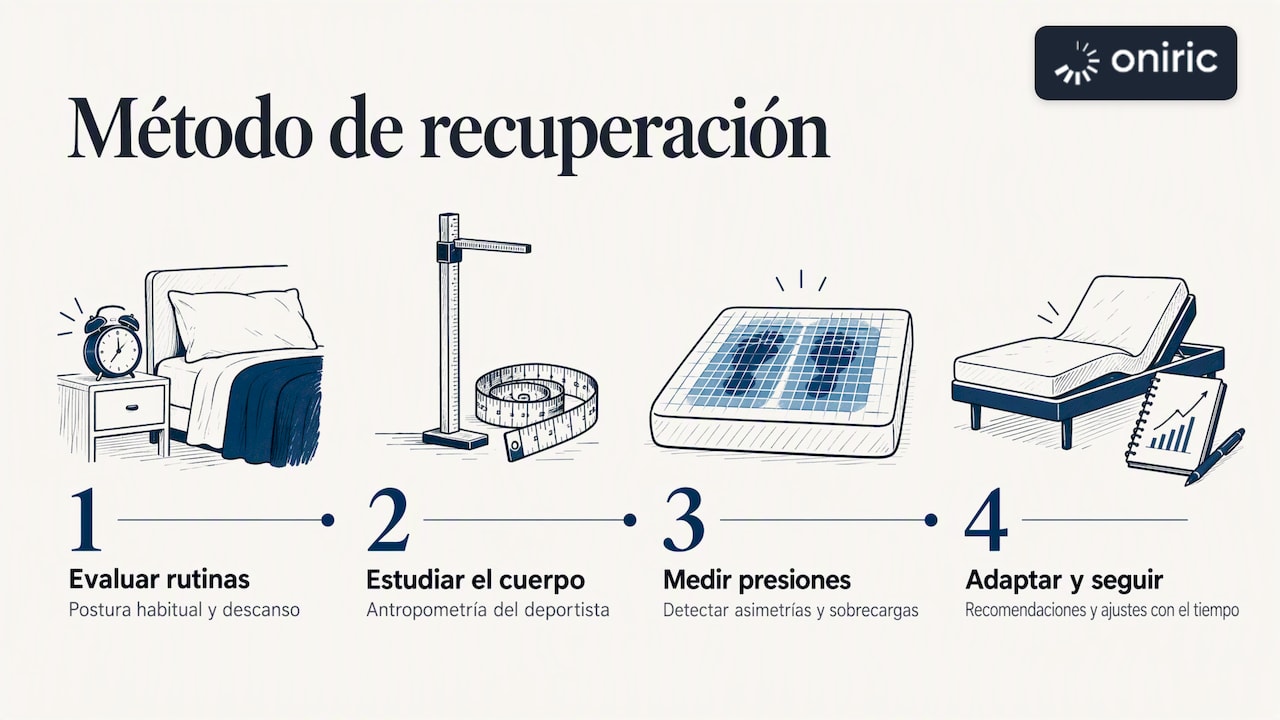
Together, these observations suggest a practical framework:
| Stage | What is assessed | What it adds |
|---|---|---|
| Anthropometric assessment | Body dimensions, proportions, and asymmetries | A baseline description of body shape |
| Sleep-habit assessment | Sleep schedule, usual position, morning discomfort | Behavioral and functional context |
| Pressure mapping | Contact-pressure distribution on a sleep surface | Identification of pressure concentrations and load asymmetries |
| Follow-up | Changes in discomfort, perceived recovery, and training load | Information to guide adjustments over time |
The Oniric Perspective
At Oniric, we see sleep as part of an athlete's recovery system, not simply what happens after the day is over. You may plan every interval session and nutrition strategy in detail, yet spend the night on a surface that provides insufficient support at the hips or concentrates pressure around a shoulder. Understanding that interaction is an often-overlooked part of a more informed approach to recovery.
That is why our Sleep Fitting™ approach brings together three complementary sources of information: sleep and recovery habits, anthropometric data, and pressure measurements taken on a sleep surface. Anthropometry tells us about body shape and proportions. Pressure mapping shows how contact loads are distributed in the positions assessed, helping reveal concentrations and asymmetries. Combined with information about sleep habits, these findings guide postural recommendations and the configuration of an ergonomic sleep system suited to the athlete.
And because bodies, training loads, and needs change over time, Oniric Recovery Evolution provides a framework for reviewing and updating the sleep system rather than treating its initial configuration as permanent.
We are equally careful about what these measurements cannot establish. An anthropometric assessment does not diagnose injuries, and persistent discomfort during sleep should be assessed by a physician or physiotherapist. What we can do is measure how the body interacts with a sleep surface and use those findings to inform more precise decisions about support.
For a deeper look at the science, read our article on biomechanics and athletic recovery, or explore more articles in the Recovery Journal.
How We Apply This at Oniric
If you're a cyclist, endurance athlete, or coach looking to apply anthropometric insights to sleep, Oniric offers a connected assessment process through Sleep Fitting™. The Recovery Profile provides an initial analysis of sleep and recovery habits, while an in-person Pressure Mapping Session adds direct measurements of how the body loads the assessment surface. The results can inform a recommendation for an Oniric PRO sleep system based on anthropometric sizing or an Oniric PRO FIT configuration tailored to the individual. Contact our team for availability and details of in-person sessions.

How to Prepare for an Anthropometric Assessment
To make your measurements useful and comparable over time, keep these points in mind:
Ask about the protocol. A qualified practitioner should be able to explain the measurement standard used, such as ISAK, and the equipment involved.
Keep conditions consistent. Where possible, use a similar time of day, hydration status, and the same assessor for repeat measurements.
Record discomfort and symptoms. Morning lower-back pain, tingling, neck stiffness, or discomfort concentrated on one side can provide useful context alongside the measurements.
Define the purpose. Body-composition monitoring, bike fitting, and sleep-system selection require different measurement priorities.
Plan follow-up assessments. Repeated measurements are more useful for identifying trends than a single result, however carefully it was taken.
Frequently asked questions
What is an anthropometric assessment?
It is a standardized set of body measurements — including weight, height, circumferences, skinfold thicknesses, and body-segment lengths — used to describe an individual’s body shape. Measurements are taken with suitable, calibrated equipment and a defined protocol. They can also support estimates of body composition and proportionality.
What measurements are included in a sports anthropometric assessment?
The CSD reference protocol includes weight, standing and sitting height, arm span, shoe size, chest, waist and hip circumferences, and selected arm and leg lengths. Skinfolds, bone breadths and other measurements may be added according to the sport and assessment objective. Consistency is essential for comparisons over time.
Can anthropometry help me choose a mattress?
Yes. Body dimensions and proportions provide useful information about support needs and potential spinal alignment. However, anthropometry cannot show where pressure is concentrated or how someone usually sleeps. Combining it with sleep-habit information and pressure mapping provides a more complete picture.
How often should it be repeated?
It depends on the purpose. Athletes may repeat measurements at key points in the training season, using comparable conditions to monitor trends. A coach or trained assessor can advise on a suitable schedule.
Who should carry out the assessment?
A practitioner trained in the selected measurement protocol, ideally with a recognized qualification in kinanthropometry, using calibrated equipment. Assessor technique directly affects reliability, so continuity between sessions is valuable.
Sources
- Anthropometry protocol — Spanish Sports Council (CSD)
- Anthropometric Measurement — PubMed
- Anthropometric Characteristics of Spanish Athletes — CSD (2012)
- Anthropometric Measurement Protocol for Athletes — EFDeportes
- Anthropometry, Tactical Position, Performance Parameters and Experience in Water Polo — Apunts
- Effects of Seat Position on Discomfort, Muscle Activation, Pressure Distribution and Pedal Force in Cyclists — PubMed
- Spinal Alignment in Men During Side-Lying Sleep — PubMed
- Unobtrusive Sleep Posture Detection Using a Smart Bed — PubMed
- Effects of Mattress Material on Body Pressure Profiles — PubMed
Conversation
0 comments
There are no comments on this article yet.
To join the conversation, you need to sign in.